' fill='%23cc0935'/%3E%3C/svg%3E)

' fill='%23cc0935'/%3E%3C/svg%3E)
'%3E%3Cg id='Group_1' data-name='Group 1' transform='translate(838.16 96.811)'%3E%3Cpath id='Path_1' data-name='Path 1' d='M13.382.347l-.563,7.2q-.709,8.68-1.336,19.87Q10.847,16.343,9.354.347H.8L5.482,39.063H17.81L21.94.347Zm9.927,38.716h8.115V.347H23.309V39.063Zm11.373,0h14.07V31.314H42.8V22.8h5.07V15.436H42.8V8.095h5.417V.347H34.682ZM73.752.347q-1.6,13.708-2.265,27.5l-.9-14.732Q69.872,2.045,69.706.346H61.28q-1.794,16.432-2.243,26.568l-.829-13.06L57.351.346H49.466L53.1,39.062H63.173q1.779-15.424,2.263-20.3,1.065,11.381,2.455,20.3H78.023L81.636.347H73.754Z' transform='translate(-0.796 -0.346)' fill='%231d1d1b' fill-rule='evenodd'/%3E%3C/g%3E%3Cpath id='Path_2' data-name='Path 2' d='M220.325,39.526h9.387q4.894,0,6.476-.693a4.349,4.349,0,0,0,2.3-2.584,17.387,17.387,0,0,0,.723-5.813V26.846a12.108,12.108,0,0,0-1-5.612,5.875,5.875,0,0,0-3.817-2.619,5.68,5.68,0,0,0,3.383-2.056,9.362,9.362,0,0,0,.858-4.732q0-5.018-1.214-7.276a6.076,6.076,0,0,0-3.19-3,17.414,17.414,0,0,0-5.811-.741h-8.1Zm9.8-31.874a1.5,1.5,0,0,1,.7.92,8.266,8.266,0,0,1,.27,2.546,14.619,14.619,0,0,1-.329,4.173q-.326.729-1.522.73c-.192,0-.462.009-.809.024V7.435a5.146,5.146,0,0,1,1.687.216Zm.55,15.016a6.148,6.148,0,0,1,.424,3.012v3.611a5.622,5.622,0,0,1-.473,2.94,2.983,2.983,0,0,1-2.188.67V22.07q1.811.073,2.236.6ZM252.456.813V29.34a17.806,17.806,0,0,1-.222,3.67.954.954,0,0,1-.993.777.882.882,0,0,1-.9-.705,14.1,14.1,0,0,1-.222-3.24V.813h-8.116V23.721q0,6.551.194,8.6a9.489,9.489,0,0,0,1.252,3.886,7.862,7.862,0,0,0,3.2,2.99,10.286,10.286,0,0,0,4.934,1.147,9.373,9.373,0,0,0,4.385-.969,7.527,7.527,0,0,0,3-2.846,9.45,9.45,0,0,0,1.369-3.658,55.93,55.93,0,0,0,.23-6.181V.813ZM280.907,11a20.617,20.617,0,0,0-.724-6.539,6.269,6.269,0,0,0-2.949-3.193A10.731,10.731,0,0,0,271.849,0a9.864,9.864,0,0,0-4.936,1.16,6.828,6.828,0,0,0-2.958,3.216,17.061,17.061,0,0,0-.916,6.5,16.667,16.667,0,0,0,.646,5.07,8.846,8.846,0,0,0,1.629,3.108,39,39,0,0,0,4.011,3.611,25.408,25.408,0,0,1,3.8,3.515q.752,1.053.752,4.472a5.417,5.417,0,0,1-.4,2.342,1.28,1.28,0,0,1-1.2.789,1.155,1.155,0,0,1-1.128-.621,7.543,7.543,0,0,1-.319-2.8v-4.71H263.29v2.535A24.491,24.491,0,0,0,264,34.911a7.084,7.084,0,0,0,3.017,3.9,9.815,9.815,0,0,0,5.562,1.531,10,10,0,0,0,5.2-1.328,6.8,6.8,0,0,0,3.015-3.288,17.6,17.6,0,0,0,.781-6.1q0-5.69-1.407-8.249t-6.826-6.548a6.74,6.74,0,0,1-2.293-2.368,7.716,7.716,0,0,1-.422-2.919,5.186,5.186,0,0,1,.376-2.25,1.193,1.193,0,0,1,1.108-.742,1.007,1.007,0,0,1,.965.55,6.874,6.874,0,0,1,.289,2.558v2.87h7.537V11Zm3.219,28.527h8.114V.813h-8.114ZM306.832.813V18.245L302.284.813H295.5V39.526h6.785v-17.6l4.221,17.6h7.113V.813Zm10.043,38.713h14.073V31.778H324.99V23.266h5.069V15.9H324.99V8.562h5.418V.812H316.875V39.526ZM350.473,11a20.642,20.642,0,0,0-.724-6.539A6.269,6.269,0,0,0,346.8,1.267,10.743,10.743,0,0,0,341.412,0a9.854,9.854,0,0,0-4.933,1.16,6.828,6.828,0,0,0-2.96,3.216,17.062,17.062,0,0,0-.916,6.5,16.7,16.7,0,0,0,.646,5.07,8.833,8.833,0,0,0,1.63,3.108,38.832,38.832,0,0,0,4.009,3.611,25.288,25.288,0,0,1,3.8,3.515q.753,1.053.752,4.472a5.417,5.417,0,0,1-.4,2.342,1.279,1.279,0,0,1-1.2.789,1.155,1.155,0,0,1-1.128-.621,7.55,7.55,0,0,1-.318-2.8v-4.71h-7.537v2.535a24.45,24.45,0,0,0,.713,6.719,7.078,7.078,0,0,0,3.016,3.9,9.816,9.816,0,0,0,5.562,1.531,10,10,0,0,0,5.2-1.328,6.8,6.8,0,0,0,3.016-3.288,17.62,17.62,0,0,0,.781-6.1q0-5.69-1.406-8.249t-6.826-6.548a6.729,6.729,0,0,1-2.294-2.368,7.716,7.716,0,0,1-.422-2.919,5.171,5.171,0,0,1,.376-2.25,1.192,1.192,0,0,1,1.108-.742,1,1,0,0,1,.964.55,6.853,6.853,0,0,1,.289,2.558v2.87h7.537V11Zm20.414,0a20.667,20.667,0,0,0-.724-6.539,6.274,6.274,0,0,0-2.95-3.193A10.742,10.742,0,0,0,361.825,0a9.856,9.856,0,0,0-4.935,1.16,6.826,6.826,0,0,0-2.959,3.216,17.048,17.048,0,0,0-.915,6.5,16.668,16.668,0,0,0,.646,5.07,8.8,8.8,0,0,0,1.629,3.108,38.884,38.884,0,0,0,4.008,3.611,25.312,25.312,0,0,1,3.8,3.515q.753,1.053.751,4.472A5.419,5.419,0,0,1,363.453,33a1.278,1.278,0,0,1-1.2.789,1.155,1.155,0,0,1-1.128-.621,7.57,7.57,0,0,1-.318-2.8v-4.71h-7.537v2.535a24.45,24.45,0,0,0,.713,6.719,7.075,7.075,0,0,0,3.016,3.9,9.816,9.816,0,0,0,5.561,1.531,9.993,9.993,0,0,0,5.2-1.328,6.8,6.8,0,0,0,3.017-3.288,17.62,17.62,0,0,0,.781-6.1q0-5.69-1.407-8.249t-6.825-6.548a6.737,6.737,0,0,1-2.294-2.368,7.733,7.733,0,0,1-.422-2.919,5.171,5.171,0,0,1,.376-2.25,1.191,1.191,0,0,1,1.108-.742,1,1,0,0,1,.963.55,6.842,6.842,0,0,1,.291,2.558v2.87h7.537V11Z' transform='translate(465.745 96)' fill='%23cc0935' fill-rule='evenodd'/%3E%3Cpath id='Path_3' data-name='Path 3' d='M0,.813V39.526H13.05V31.779H8.115V.812H0Zm18.3,0-4.14,38.714h8.39l.487-6.959h2.9l.435,6.959h8.293L30.026.813Zm4.634,24.892q.318-5.14,1.558-16.259.621,9.683,1.236,16.259ZM47.379.813V18.245L42.83.813H36.044V39.526H42.83v-17.6l4.221,17.6h7.113V.813H47.378Zm28.99,13.181a31.659,31.659,0,0,0-.732-7.987,7.966,7.966,0,0,0-3.066-4.287A9.711,9.711,0,0,0,66.653,0,9.588,9.588,0,0,0,61.98,1.112,8.178,8.178,0,0,0,58.8,4.161a9.993,9.993,0,0,0-1.378,4.03,62,62,0,0,0-.232,6.276v11.31a35.789,35.789,0,0,0,.752,8.525,7.574,7.574,0,0,0,3.065,4.435,10.093,10.093,0,0,0,5.879,1.6,8.894,8.894,0,0,0,5.773-1.891,8.513,8.513,0,0,0,3.026-4.407,36.619,36.619,0,0,0,.685-8.525V24.007H68.254v4.866a17.358,17.358,0,0,1-.28,4.051,1.267,1.267,0,0,1-2.4,0,15.435,15.435,0,0,1-.27-3.682V11.262a16.565,16.565,0,0,1,.27-3.825,1.191,1.191,0,0,1,1.272-.884,1.087,1.087,0,0,1,1.147.727,14.846,14.846,0,0,1,.261,3.662v6.728h8.115V13.993ZM81.577.812,77.438,39.526h8.389l.488-6.959h2.9l.436,6.959h8.291L93.308.813H81.577ZM86.213,25.7q.317-5.14,1.557-16.259.619,9.683,1.237,16.259H86.212ZM116.519,11a20.684,20.684,0,0,0-.723-6.54,6.262,6.262,0,0,0-2.95-3.192A10.725,10.725,0,0,0,107.459,0a9.84,9.84,0,0,0-4.935,1.16,6.826,6.826,0,0,0-2.958,3.215,17.064,17.064,0,0,0-.916,6.5,16.672,16.672,0,0,0,.646,5.07,8.862,8.862,0,0,0,1.629,3.108,38.959,38.959,0,0,0,4.009,3.61,25.357,25.357,0,0,1,3.8,3.515q.752,1.053.752,4.472a5.4,5.4,0,0,1-.4,2.343,1.278,1.278,0,0,1-1.2.789,1.155,1.155,0,0,1-1.128-.621,7.556,7.556,0,0,1-.318-2.8V25.657H98.9v2.534a24.506,24.506,0,0,0,.712,6.72,7.083,7.083,0,0,0,3.017,3.9,9.828,9.828,0,0,0,5.561,1.53,10.011,10.011,0,0,0,5.2-1.326,6.8,6.8,0,0,0,3.017-3.289,17.639,17.639,0,0,0,.781-6.1q0-5.692-1.407-8.25t-6.825-6.548a6.735,6.735,0,0,1-2.294-2.367,7.722,7.722,0,0,1-.422-2.919,5.186,5.186,0,0,1,.376-2.25,1.192,1.192,0,0,1,1.108-.742,1,1,0,0,1,.964.549,6.856,6.856,0,0,1,.289,2.559v2.868h7.537V11ZM130.283.813V14.658h-2.429V.813h-8.115V39.526h8.115V23.266h2.429V39.526H138.4V.813Zm11.373,38.714h8.115V.813h-8.115Zm11.372,0h8.115V22.071q1.676,0,2.072.741a10.845,10.845,0,0,1,.4,3.85V39.526h7.536V29.316a44.475,44.475,0,0,0-.2-5.727,6.461,6.461,0,0,0-1.03-2.283,5.808,5.808,0,0,0-3.239-1.985q2.66-.312,3.566-1.865t.905-6.074q0-4.949-1.281-7.209a5.481,5.481,0,0,0-3.316-2.81,35.563,35.563,0,0,0-7.777-.55h-5.744V39.526ZM163.079,8.01a3.786,3.786,0,0,1,.531,2.415v2.128q0,2.56-.55,3.025a3.011,3.011,0,0,1-1.918.466V7.437A2.589,2.589,0,0,1,163.079,8.01Zm11.208,31.516h14.071V31.779H182.4V23.266h5.069V15.9H182.4V8.56h5.416V.813H174.288V39.526Z' transform='translate(495 96)' fill='%231d1d1b' fill-rule='evenodd'/%3E%3C/g%3E%3C/svg%3E)
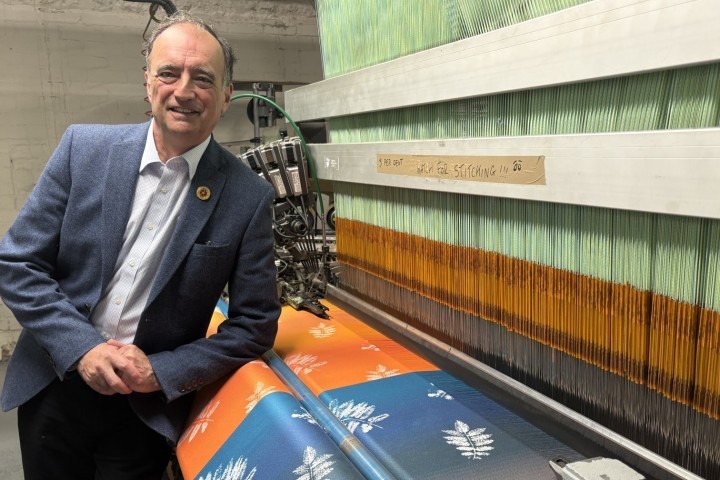
The textile trade isn’t just part of David Collinge’s family story. It is woven into its very fabric.
The 62-year-old new High Sheriff of Lancashire’s life and career have been shaped by the industry. It runs through his story like an unbroken thread.
A sixth-generation weaver, David spent most of his working life in his family’s business. John Spencer Textiles has been part of Burnley’s industrial story for more than 150 years.
Now retired from day-to-day business life, he has stepped into one of the county’s most historic civic roles.
During his year as high sheriff, he hopes to shine a light on organisations supporting victims of crime, rehabilitation and reintegration, those who are often working quietly and without public recognition.
The role is quite a departure for David.
He says: “I’m not a natural public figure, I’ve spent most of my working life behind the scenes, trying to solve problems and keep a business moving forward.”
Born in Nelson and now living in the Ribble Valley, David is quick to define himself not by office, but by trade. “I always describe myself first and foremost as a Lancashire weaver,” he declares. “That’s who I am.”
David’s great great great grandfather began weaving on the hills above Burnley in the mid 19th century, when subsistence farmers wove cloth during the winter months to supplement their income.
As industrialisation accelerated, the family moved into the town, installing their first mechanised looms on Trafalgar Street.
From there, the business grew steadily, eventually building its own mill and, by 1920, operating more than 2,400 looms across two sites.
David hadn’t planned on joining the family business. He trained as a press photographer and went on to work for a daily newspaper in East Anglia.
However, the pull of the family firm proved strong. David studied for a degree in textile technology, with a dissertation on ‘how to modernise and rebuild an old Lancashire mill’.
That piece of work became relevant in 1991 when disaster struck and the mill was almost completely destroyed by fire. David says: “I found the whole place collapsed and smoking.
"We lost 120 looms. It was traumatic, but it also gave us a clean start.”
With extraordinary commitment from the workforce and strong support from insurers, the business rebuilt and was operational again within 12 months. The fire accelerated modernisation, opening the door to new technical markets and specialist work.
David stepped fully into leadership at a time when the industry itself was shrinking rapidly.
He says: “I’ve had no leadership training at all.
“It was about getting down and dirty, understanding people’s jobs, and not being frightened of making decisions, even if they didn’t always work."
As managing director, David reshaped the company into a manufacturing business that operates more like a service partner.
“We didn’t second guess customers – we worked with them,” he says.
That approach became critical when changes to government procurement rules wiped out a third of the company’s turnover almost overnight, as UK military uniforms were no longer required to be sourced domestically.
David says: “It was a huge shock. We realised that we were exposed.”
His response was strategic. The business became its own customer.
The owner of a London based niche furnishing retailer was approaching retirement. David acquired the business and built it into a design led brand, supplying retail, trade and export markets.
Sister company Ian Mankin specialises in designer furnishing fabrics all woven at John Spencer’s mill. Over time it would represent more than a third of turnover.
David says: “High margin, smaller volume, specialist work is what secured the future.
“The business is one of the very few places left that can take a fabric from a concept all the way through to the retail market.”
In 2023, David was awarded the Coronation Medal in recognition of his contribution to the creation of the Anointing Screen. Used during the Coronation of King Charles III, the screen provided a sacred space during the most solemn moment of the ceremony and reflected centuries of craftsmanship.
David says: “When the King politely says, ‘This is what I would like,’ you do everything you can to deliver it. And yes, I even got to put a few stitches in myself.”
Shortly afterwards, he completed a carefully planned succession, handing the business to long standing colleague Simon Blackley in a management buy-out.
Despite stepping away, David is still enthused about textiles and challenges some people’s perceptions of the industry as something from the past. He sees it very much as a vital part of the future.
He remains actively involved with The Weavers Company, the oldest livery company in the City of London, where as chair of the textile committee he has championed textile education, supported emerging designers and technologists, and promoted excellence in British textile manufacturing.
He says: “I’m a bore when I go out, because the fantastic thing about the textile industry is that wherever you go, the textile industry is there.
“The world we live in is a textile world and people just don’t realise it. I go on holiday and when we get on an aeroplane I say to people, ‘Do you realise that you’re flying in a bit of textiles here?’
“The plane is 80 per cent textiles, including the engines, the fuselage, the wings. They’re all made of carbon fibre and then you’ve got the curtains and the chairs. When you get in your car, the bearings and the steering columns, the tyres – they are full of textiles.”
Looking at the year ahead and his new role, David says: “It feels daunting. But if I can spend a year thanking people, spotlighting work that often goes unseen and bringing people together, that will be time well spent.”
His newly designed coat of arms which is soon to hang in Lancaster Castle features weaving shuttles and bears a single word family motto: ‘Now’. He explains: “We do it now. Life’s more interesting that way."
David's take on leadership
What do you think makes a good leader?
A good leader brings people together and helps them do their best. It’s about listening, showing integrity, and offering encouragement. Like weaving, leadership is about connecting different threads – people, skills, and ideas - into something stronger. The best leaders don’t seek the spotlight, they create the conditions for others to succeed.
Which leaders have inspired you and why?
I’ve been inspired by King Charles III for his lifelong commitment to service, and Nelson Mandela for his capacity for forgiveness and unity. I’m equally inspired by leaders across voluntary organisations and charities. Their quiet, selfless commitment, often unseen, holds communities together and changes lives every day.
What qualities does a leader need?
A leader needs integrity, empathy, and the ability to listen well. They should show calm judgement, resilience, and a willingness to serve others rather than themselves. Good leaders build trust, bring people together, and give clarity in uncertain moments, while having the humility to keep learning and the courage to make difficult decisions when it matters.
' fill='%23cc0935'/%3E%3C/svg%3E)
' fill='%23cc0935'/%3E%3C/svg%3E)
Enjoyed this? Read more from Rob Kelly