' fill='%23cc0935'/%3E%3C/svg%3E)

' fill='%23cc0935'/%3E%3C/svg%3E)
'%3E%3Cg id='Group_1' data-name='Group 1' transform='translate(838.16 96.811)'%3E%3Cpath id='Path_1' data-name='Path 1' d='M13.382.347l-.563,7.2q-.709,8.68-1.336,19.87Q10.847,16.343,9.354.347H.8L5.482,39.063H17.81L21.94.347Zm9.927,38.716h8.115V.347H23.309V39.063Zm11.373,0h14.07V31.314H42.8V22.8h5.07V15.436H42.8V8.095h5.417V.347H34.682ZM73.752.347q-1.6,13.708-2.265,27.5l-.9-14.732Q69.872,2.045,69.706.346H61.28q-1.794,16.432-2.243,26.568l-.829-13.06L57.351.346H49.466L53.1,39.062H63.173q1.779-15.424,2.263-20.3,1.065,11.381,2.455,20.3H78.023L81.636.347H73.754Z' transform='translate(-0.796 -0.346)' fill='%231d1d1b' fill-rule='evenodd'/%3E%3C/g%3E%3Cpath id='Path_2' data-name='Path 2' d='M220.325,39.526h9.387q4.894,0,6.476-.693a4.349,4.349,0,0,0,2.3-2.584,17.387,17.387,0,0,0,.723-5.813V26.846a12.108,12.108,0,0,0-1-5.612,5.875,5.875,0,0,0-3.817-2.619,5.68,5.68,0,0,0,3.383-2.056,9.362,9.362,0,0,0,.858-4.732q0-5.018-1.214-7.276a6.076,6.076,0,0,0-3.19-3,17.414,17.414,0,0,0-5.811-.741h-8.1Zm9.8-31.874a1.5,1.5,0,0,1,.7.92,8.266,8.266,0,0,1,.27,2.546,14.619,14.619,0,0,1-.329,4.173q-.326.729-1.522.73c-.192,0-.462.009-.809.024V7.435a5.146,5.146,0,0,1,1.687.216Zm.55,15.016a6.148,6.148,0,0,1,.424,3.012v3.611a5.622,5.622,0,0,1-.473,2.94,2.983,2.983,0,0,1-2.188.67V22.07q1.811.073,2.236.6ZM252.456.813V29.34a17.806,17.806,0,0,1-.222,3.67.954.954,0,0,1-.993.777.882.882,0,0,1-.9-.705,14.1,14.1,0,0,1-.222-3.24V.813h-8.116V23.721q0,6.551.194,8.6a9.489,9.489,0,0,0,1.252,3.886,7.862,7.862,0,0,0,3.2,2.99,10.286,10.286,0,0,0,4.934,1.147,9.373,9.373,0,0,0,4.385-.969,7.527,7.527,0,0,0,3-2.846,9.45,9.45,0,0,0,1.369-3.658,55.93,55.93,0,0,0,.23-6.181V.813ZM280.907,11a20.617,20.617,0,0,0-.724-6.539,6.269,6.269,0,0,0-2.949-3.193A10.731,10.731,0,0,0,271.849,0a9.864,9.864,0,0,0-4.936,1.16,6.828,6.828,0,0,0-2.958,3.216,17.061,17.061,0,0,0-.916,6.5,16.667,16.667,0,0,0,.646,5.07,8.846,8.846,0,0,0,1.629,3.108,39,39,0,0,0,4.011,3.611,25.408,25.408,0,0,1,3.8,3.515q.752,1.053.752,4.472a5.417,5.417,0,0,1-.4,2.342,1.28,1.28,0,0,1-1.2.789,1.155,1.155,0,0,1-1.128-.621,7.543,7.543,0,0,1-.319-2.8v-4.71H263.29v2.535A24.491,24.491,0,0,0,264,34.911a7.084,7.084,0,0,0,3.017,3.9,9.815,9.815,0,0,0,5.562,1.531,10,10,0,0,0,5.2-1.328,6.8,6.8,0,0,0,3.015-3.288,17.6,17.6,0,0,0,.781-6.1q0-5.69-1.407-8.249t-6.826-6.548a6.74,6.74,0,0,1-2.293-2.368,7.716,7.716,0,0,1-.422-2.919,5.186,5.186,0,0,1,.376-2.25,1.193,1.193,0,0,1,1.108-.742,1.007,1.007,0,0,1,.965.55,6.874,6.874,0,0,1,.289,2.558v2.87h7.537V11Zm3.219,28.527h8.114V.813h-8.114ZM306.832.813V18.245L302.284.813H295.5V39.526h6.785v-17.6l4.221,17.6h7.113V.813Zm10.043,38.713h14.073V31.778H324.99V23.266h5.069V15.9H324.99V8.562h5.418V.812H316.875V39.526ZM350.473,11a20.642,20.642,0,0,0-.724-6.539A6.269,6.269,0,0,0,346.8,1.267,10.743,10.743,0,0,0,341.412,0a9.854,9.854,0,0,0-4.933,1.16,6.828,6.828,0,0,0-2.96,3.216,17.062,17.062,0,0,0-.916,6.5,16.7,16.7,0,0,0,.646,5.07,8.833,8.833,0,0,0,1.63,3.108,38.832,38.832,0,0,0,4.009,3.611,25.288,25.288,0,0,1,3.8,3.515q.753,1.053.752,4.472a5.417,5.417,0,0,1-.4,2.342,1.279,1.279,0,0,1-1.2.789,1.155,1.155,0,0,1-1.128-.621,7.55,7.55,0,0,1-.318-2.8v-4.71h-7.537v2.535a24.45,24.45,0,0,0,.713,6.719,7.078,7.078,0,0,0,3.016,3.9,9.816,9.816,0,0,0,5.562,1.531,10,10,0,0,0,5.2-1.328,6.8,6.8,0,0,0,3.016-3.288,17.62,17.62,0,0,0,.781-6.1q0-5.69-1.406-8.249t-6.826-6.548a6.729,6.729,0,0,1-2.294-2.368,7.716,7.716,0,0,1-.422-2.919,5.171,5.171,0,0,1,.376-2.25,1.192,1.192,0,0,1,1.108-.742,1,1,0,0,1,.964.55,6.853,6.853,0,0,1,.289,2.558v2.87h7.537V11Zm20.414,0a20.667,20.667,0,0,0-.724-6.539,6.274,6.274,0,0,0-2.95-3.193A10.742,10.742,0,0,0,361.825,0a9.856,9.856,0,0,0-4.935,1.16,6.826,6.826,0,0,0-2.959,3.216,17.048,17.048,0,0,0-.915,6.5,16.668,16.668,0,0,0,.646,5.07,8.8,8.8,0,0,0,1.629,3.108,38.884,38.884,0,0,0,4.008,3.611,25.312,25.312,0,0,1,3.8,3.515q.753,1.053.751,4.472A5.419,5.419,0,0,1,363.453,33a1.278,1.278,0,0,1-1.2.789,1.155,1.155,0,0,1-1.128-.621,7.57,7.57,0,0,1-.318-2.8v-4.71h-7.537v2.535a24.45,24.45,0,0,0,.713,6.719,7.075,7.075,0,0,0,3.016,3.9,9.816,9.816,0,0,0,5.561,1.531,9.993,9.993,0,0,0,5.2-1.328,6.8,6.8,0,0,0,3.017-3.288,17.62,17.62,0,0,0,.781-6.1q0-5.69-1.407-8.249t-6.825-6.548a6.737,6.737,0,0,1-2.294-2.368,7.733,7.733,0,0,1-.422-2.919,5.171,5.171,0,0,1,.376-2.25,1.191,1.191,0,0,1,1.108-.742,1,1,0,0,1,.963.55,6.842,6.842,0,0,1,.291,2.558v2.87h7.537V11Z' transform='translate(465.745 96)' fill='%23cc0935' fill-rule='evenodd'/%3E%3Cpath id='Path_3' data-name='Path 3' d='M0,.813V39.526H13.05V31.779H8.115V.812H0Zm18.3,0-4.14,38.714h8.39l.487-6.959h2.9l.435,6.959h8.293L30.026.813Zm4.634,24.892q.318-5.14,1.558-16.259.621,9.683,1.236,16.259ZM47.379.813V18.245L42.83.813H36.044V39.526H42.83v-17.6l4.221,17.6h7.113V.813H47.378Zm28.99,13.181a31.659,31.659,0,0,0-.732-7.987,7.966,7.966,0,0,0-3.066-4.287A9.711,9.711,0,0,0,66.653,0,9.588,9.588,0,0,0,61.98,1.112,8.178,8.178,0,0,0,58.8,4.161a9.993,9.993,0,0,0-1.378,4.03,62,62,0,0,0-.232,6.276v11.31a35.789,35.789,0,0,0,.752,8.525,7.574,7.574,0,0,0,3.065,4.435,10.093,10.093,0,0,0,5.879,1.6,8.894,8.894,0,0,0,5.773-1.891,8.513,8.513,0,0,0,3.026-4.407,36.619,36.619,0,0,0,.685-8.525V24.007H68.254v4.866a17.358,17.358,0,0,1-.28,4.051,1.267,1.267,0,0,1-2.4,0,15.435,15.435,0,0,1-.27-3.682V11.262a16.565,16.565,0,0,1,.27-3.825,1.191,1.191,0,0,1,1.272-.884,1.087,1.087,0,0,1,1.147.727,14.846,14.846,0,0,1,.261,3.662v6.728h8.115V13.993ZM81.577.812,77.438,39.526h8.389l.488-6.959h2.9l.436,6.959h8.291L93.308.813H81.577ZM86.213,25.7q.317-5.14,1.557-16.259.619,9.683,1.237,16.259H86.212ZM116.519,11a20.684,20.684,0,0,0-.723-6.54,6.262,6.262,0,0,0-2.95-3.192A10.725,10.725,0,0,0,107.459,0a9.84,9.84,0,0,0-4.935,1.16,6.826,6.826,0,0,0-2.958,3.215,17.064,17.064,0,0,0-.916,6.5,16.672,16.672,0,0,0,.646,5.07,8.862,8.862,0,0,0,1.629,3.108,38.959,38.959,0,0,0,4.009,3.61,25.357,25.357,0,0,1,3.8,3.515q.752,1.053.752,4.472a5.4,5.4,0,0,1-.4,2.343,1.278,1.278,0,0,1-1.2.789,1.155,1.155,0,0,1-1.128-.621,7.556,7.556,0,0,1-.318-2.8V25.657H98.9v2.534a24.506,24.506,0,0,0,.712,6.72,7.083,7.083,0,0,0,3.017,3.9,9.828,9.828,0,0,0,5.561,1.53,10.011,10.011,0,0,0,5.2-1.326,6.8,6.8,0,0,0,3.017-3.289,17.639,17.639,0,0,0,.781-6.1q0-5.692-1.407-8.25t-6.825-6.548a6.735,6.735,0,0,1-2.294-2.367,7.722,7.722,0,0,1-.422-2.919,5.186,5.186,0,0,1,.376-2.25,1.192,1.192,0,0,1,1.108-.742,1,1,0,0,1,.964.549,6.856,6.856,0,0,1,.289,2.559v2.868h7.537V11ZM130.283.813V14.658h-2.429V.813h-8.115V39.526h8.115V23.266h2.429V39.526H138.4V.813Zm11.373,38.714h8.115V.813h-8.115Zm11.372,0h8.115V22.071q1.676,0,2.072.741a10.845,10.845,0,0,1,.4,3.85V39.526h7.536V29.316a44.475,44.475,0,0,0-.2-5.727,6.461,6.461,0,0,0-1.03-2.283,5.808,5.808,0,0,0-3.239-1.985q2.66-.312,3.566-1.865t.905-6.074q0-4.949-1.281-7.209a5.481,5.481,0,0,0-3.316-2.81,35.563,35.563,0,0,0-7.777-.55h-5.744V39.526ZM163.079,8.01a3.786,3.786,0,0,1,.531,2.415v2.128q0,2.56-.55,3.025a3.011,3.011,0,0,1-1.918.466V7.437A2.589,2.589,0,0,1,163.079,8.01Zm11.208,31.516h14.071V31.779H182.4V23.266h5.069V15.9H182.4V8.56h5.416V.813H174.288V39.526Z' transform='translate(495 96)' fill='%231d1d1b' fill-rule='evenodd'/%3E%3C/g%3E%3C/svg%3E)

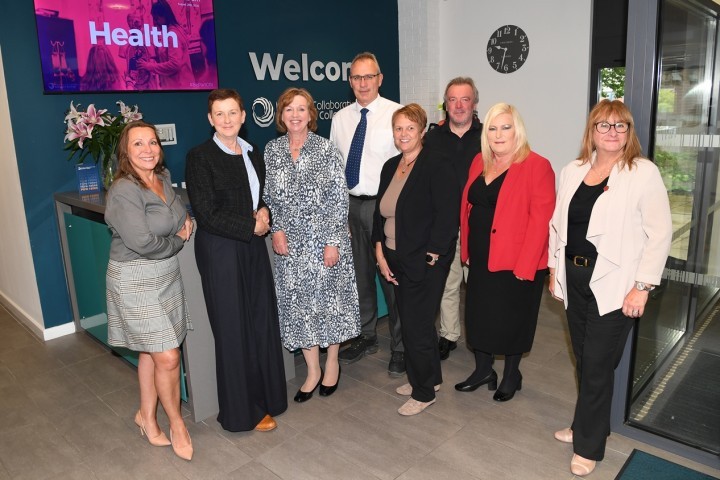
We brought together industry and business leaders at Blackburn College to discuss what Lancashire's next generation of manufacturing might look like.
Bryan Welch
Perspex International
I see a number of challenges we need to overcome, particularly in our industry, which is very energy intensive. It is about finding our way forward in a high energy environment and managing the cost of energy, but also moving towards automation. There’s a strong need for more automation and the skills we need must be adjusted into that world where we have higher levels of automation in manufacturing.
Addressing recruitment challenges is possibly down to schools and parenting. Historically, manufacturing was something you did if you weren’t doing well at school. Parents might say: “You’re going to end up in that factory.” But the reality is completely different, it shouldn’t be the case any more. Wages are higher in manufacturing on average across the board.
In a manufacturing business like ours, so many people who joined in one area are now doing something completely different. Our company is full of people who started as plant operators and they are now accountants or production schedulers. I started as a sales rep and now I’m operations director.
We have someone who started in our accounts payable department who is now a plant manager and when people express an interest in going into something new, then we retrain them. We provide the training for them to go back to college on a part time basis and they get the skills and then they develop through the company.
Paula Gill
North West Aerospace Alliance
At this moment in time in Lancashire we have such a condensed area of manufacturers, not just across aerospace and defence but across automotive, manufacturing for nuclear components. What we have a need for now is change, and that change comes with people and skills.
We have backlogs of orders, we have changing technology, and changing product. We have businesses that need to invest to be able to keep up with the changes first of all. Then we’ve got to ramp up the rate. If we have an existing supply chain that needs to do more, how are they going to do more if they haven’t got the people, they haven’t got the facilities, they haven’t got the equipment, they haven’t been able to secure the materials. So we have to address a much wider ecosystem that ultimately feeds into our overall economy.
A lot of our SMEs cannot afford to just sit within one sector, they actually have a huge skill base in small businesses to be able to de-risk, grow their operation and work across multiple sectors. So when we talk about aerospace and defence, the chances are that business is going to be working in automotive, or they might have contracts in nuclear, or even food and drink. So we have to be mindful we can’t just ask businesses to change for one sector, we have to change the whole thing.
Darren Grantham
Make UK
It is like a perfect storm at the minute, it is not easy to be a manufacturer in the UK. You are facing the highest energy costs in Europe and skills shortages. It is not seen as an attractive business to be entering into as your career, which is slightly ridiculous because you go inside any engineering company or manufacturing company and there are really exciting things going on.
And people don’t see the other opportunities, the accountant, the marketing person, and the others required to run a business. We are seeing an ageing workforce as well. Where are the new skills coming from? Who’s going to replace these people who are at retirement age, and it’s not a place that looks attractive to young people when you see that kind of ageing workforce.
Every year Make UK does National Manufacturing Day where we encourage our members to open the doors of their businesses for schools and colleges to come in and have a look at what goes on there. It’s a difficult ask because there’s all sorts of health and safety issues and things like that, but we do get a really good uptake on it and that’s always in September, so we’ve got that coming up and it’s a big thing in our calendar.
It’s all about peer to peer collaboration. It’s the companies that are looking out from their businesses that are going to be successful, not the ones who have their heads down in the business.
Melissa Conlon
Advanced Manufacturing Research Centre North West
I don’t think it’s all doom and gloom. If you look at Lancashire compared to the rest of the country, I think we are doing very well. If you look at manufacturing in Lancashire, it’s not going to be a case of what we made previously, it’s a case of what do we want to make in the future. We have those choices because of the sectors we are in with aerospace. We have clean tech, energy, nuclear, and I think they’re going to be coming and knocking on our doors. I think all the skills challenges, we can actually solve them.
We cannot underestimate the breadth of our supply chain. That’s probably Lancashire’s superpower really, in terms of the breadth of it. And what we are not doing enough of is mapping capabilities and our clusters, so when we actually go and speak to government we don’t have enough information to drive that inward investment.
If you look at our careers, historically they have been linear. I look at CVs sometimes and if somebody has moved around a lot, 10 years ago that would go to the bottom of my pile and I would not take that person on. I look at it now and I think, okay, so what have you gained from that role as opposed to what you did in that role, what was different about that, and when I’m interviewing them I really dig deeply into what skills they’ve learned.
Karen Keighley
Tapeswitch
I went into Tapeswitch as a salesperson and I trained in marketing at Blackburn and also at Lancaster University. I did a lot of personal development and I am now the MD of the company, so it stands to reason that it’s a great way to actually achieve something. I do not consider myself a manufacturer, but you can’t have a manufacturing company without somebody that knows about accounts and finance and people and everything else. I don’t know how to make anything, but I know how to run the company.
When it comes to recruitment, I have always employed people based on their attitude over their skills. You can teach someone to weld or solder or whatever, but you can’t teach people how to be on time, how to interact with other colleagues, and that sort of thing.
For us to remain competitive as a business we have to embrace new technologies but, right now, I don’t know where to look. I need somebody that knows about manufacturing, who also knows about AI and can also do some productivity stuff as well. I am part of the Manufacturers Alliance, but that is more a product company rather than a service company. My biggest pain point is that I am probably the only tech savvy person in the company, and I am not very techy. I’ve only just got an iPhone.
Sara Gaskell
Lancashire Skills and Employment Hub
One of the things we need to be mindful of is around automation and AI, and how we get that message out to feed future talent pipelines. We need to be making sure businesses are more involved in the design and development of curriculums and are getting involved with schools and colleges to support young people so they have that throughput of talent to make them effective in the future.
There is a massive ask on businesses across the whole of the education and skills sector and that is a difficult balance. The likes of Blackburn College have their business boards and they bring businesses around the table, which is a fabulous idea. The Department for Work and Pensions now delivers skills boot camps but unless businesses tell us what they want it’s very difficult to use that funding for the most appropriate thing. So for us it’s a collaboration between business and education informing future skills needs.
We work alongside the Lancashire Careers Hub which works across schools, special schools and Pupil Referral Units (PRUs) in Lancashire. They then work with more than 200 business volunteers to get real work experience and information. It is sometimes difficult because businesses are busy, but we need to get business information into schools so young people can make those informed choices.
Part of the issue is that businesses may want to get involved with skills but don’t know how to do it. They might want to get involved with T-levels but they don’t know how to do it and a few years ago now, we designed the Lancashire Skills Pledge, which is one front door for businesses to find out about the skills initiatives.
Kate Houlden
Like Technologies
Things have to change and things have to move on. But we do have quite a lot of facilities in this area and there are businesses that are not just pure manufacturing businesses. They may be product businesses or service businesses that are looking for the services of manufacturers. It’s not just thinking about the manufacturers themselves, it’s also thinking about all of those supply chains that sit behind it.
As a company we have been working on masterclasses in terms of curriculum and education projects, including sessions for colleges. What we are starting, as well as T-level placements, is to get some of the tutors from colleges in the north of Lancashire out to some of these SMEs because they don’t actually keep abreast of what these SMEs are doing, and what they can offer.
T-levels are a good example of where people that are just as capable as A-level students can take on a more practical qualification. My experience is that we have taken students in terms of placements and we have seen some outstanding people come through that route and, when they have finished college and passed the qualification, they have then actually come to us wanting to do a degree apprenticeship. This is not a second class citizen in terms of education, this is something that is a good route for somebody that wants something slightly different to A-levels but it still can lead on to university if that is what the student and the business wants.
Claire Shore
Blackburn College
We focus on the technical skills that those who come to study with us at whatever age and phase of their career need, and that’s fundamentally important. Of equal importance is the digital maturity that people leave our organisation with and the organisational understanding, not of our institution, but of how organisations work.
It is about preparing all of our learners, but particularly the young people who are coming from school, for their careers and towards work readiness. It is no longer just about telling them the jobs they are going to be doing in the future won’t be the same as the jobs that exist today. I would lean to a really old phrase, which is, ‘if you can see it, you can be it’. From a skills perspective, we can teach the things our business community wants, but the real value comes when our students go into a business and see what they are doing.
At Blackburn College we have actively used the 10 work ready skills that were produced out of the Lancashire Skills and Employment Hub. The fact that multiple organisations and institutions around Lancashire are using those same words, the same language, helps get that conversation going.
' fill='%23cc0935'/%3E%3C/svg%3E)
' fill='%23cc0935'/%3E%3C/svg%3E)
Enjoyed this? Read more from Dan Clough